
One Platform
The silos were never your choice. Removing them is.
The fibre is in a GIS, the devices in an inventory, the services in an OSS, the customers in a CRM, the changes in a ticketing tool, the projects in a planning tool and the budgets in spreadsheets. DemandFlow® puts them in one record set, referencing each other down to the strand, so the questions that cross them are answered from the records rather than assembled by a person.
The Challenge
Every silo is right about its own corner. None can answer the question that crosses them.
Which customers lose service if this duct is cut? Does this change clash with that one? What will the platform going out of support next year cost, and is the project that pays for it on track? Each answer lives across four systems, and integration only adds a fifth thing to maintain. The answer is still assembled by hand, and it is out of date by the time it is read.

Data silos
The same site, device, customer or person exists in several systems with different names, different states and no reference between them.

Technology silos
Physical, logical, radio, IT, delivery and finance tools from different vendors, each with its own model, interface, API and upgrade cycle.

Integration debt
Every connector is code to maintain, a mapping to keep current and a failure mode nobody notices until the numbers disagree.
One record set
From the customer to the strand, in one picture
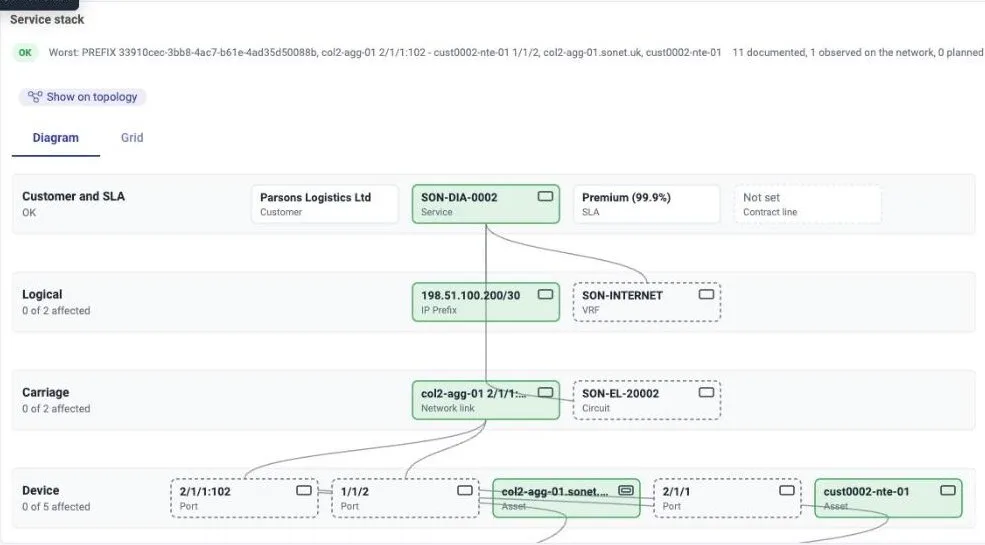
A service sold to a customer carries its contract line and SLA, the VRF and prefix that realise it, the link that carries it, the circuit and wavelength beneath, the ports and devices, the patch cords and the fibre path down to the strands, cables, closures and ducts. The service stack draws it with health from open alerts and a completeness score per layer. Nothing on that picture was integrated from somewhere else.
- Physical plant, racks, power, devices, links, services and customers as typed references, not text matches
- Towers, antennas and cells joined to the fibre fronthaul, backhaul links and the sites they share with the fixed network
- IT and telecom estates kept apart, sharing the people, vendors, contracts, tickets and knowledge where they should
Operations and change
Changes, outages and alerts assessed against the real dependencies
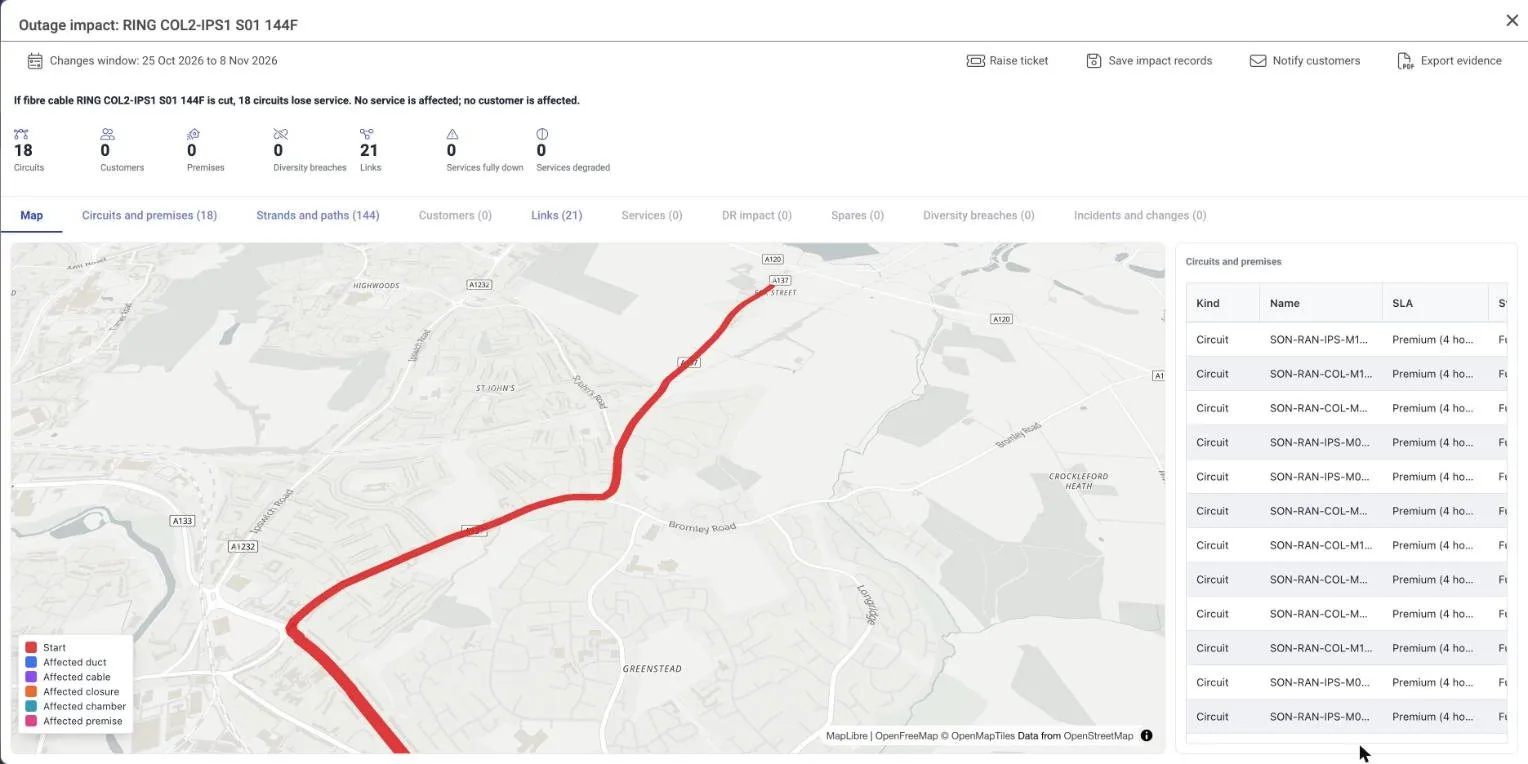
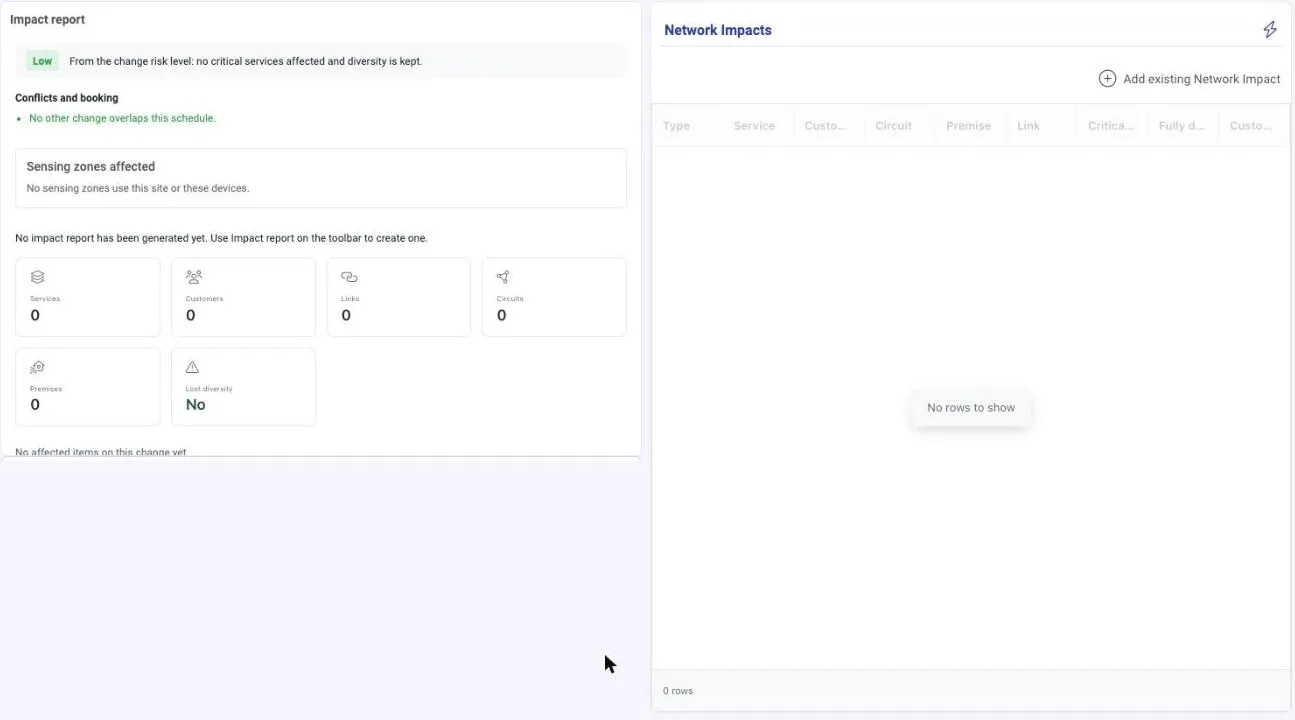
A network change names the plant and devices it touches; the platform works out the services, customers and premises affected, scores the risk, checks the booking against other changes and freeze windows, warns the sensing customers whose zones depend on the site, and verifies the result against a discovery snapshot taken before and after. A SIEM alert on a link arrives already knowing the carriers, services and customers that ride on it.
Delivery and money
From end of support to a funded project, without re-keying
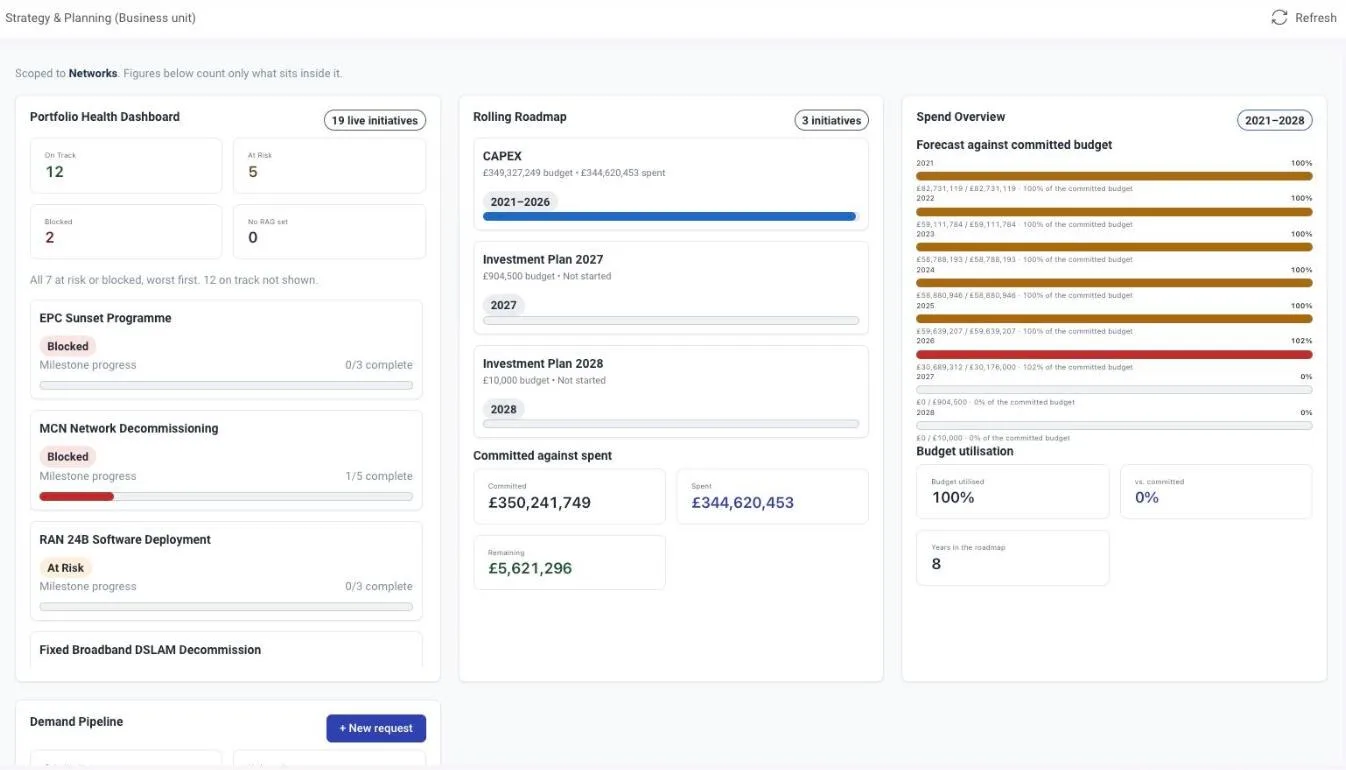
A platform version’s end-of-support date becomes a draft demand with impact and cost of delay, a line on the department’s investment plan priced from its own closed projects, a decision made against the business unit’s headroom, and on release a project with its roadmap and forecast lines already written. The project’s people are visible across every other plan, its spend sits in the tracker the CFO’s dashboard reads, and its status report is pre-drafted every morning.
Built to unify
One record model, one write path, one interface, definitions you own

One record model
Over a thousand entity definitions, every reference a typed lookup. The dependency graph behind impact, blast radius, what-if and completeness is built from those references, so it is always current.

One write path
Every create, update and delete, from a screen, an import, a flow, the REST API or an AI assistant, passes the same rules, fires the same automations, keeps the same history and delivers the same webhooks.

Definitions you own
Tailor any entity for your tenant or add new ones without code. Everything you add is on the API, in the assistant tools, in automations, imports and exports from the moment it is published.
Bring your data in
From spreadsheets, data silos, lakes and other platforms, matched to the records they belong to
Unifying silos starts by emptying them. DemandFlow loads what you already have from wherever it lives: the spreadsheets teams keep, the exports from the systems you are replacing, the lake your warehouse team maintains, and the platforms that will stay. Imports run as a dry run first with an error report, discovery proposes differences rather than overwriting the record, and every loaded record keeps its source.
Spreadsheets and files
CSV and Excel with column mapping, dry run and error report; module importers that understand fibre, data centre, RAN, ledger, purchase order, patent, recruitment and project files; Workbooks datasets in CSV, Excel, JSON, Parquet, GeoJSON, KML and KMZ, promoted to records in bulk.
Data lakes and warehouses
Parquet and JSON datasets queried beside the live records; GL actuals picked up from your SFTP server on a schedule; log archives written to your own storage and searchable there; an OData feed so Power BI and your warehouse read DemandFlow as a source.
Other platforms
Discovery from the DemandFlow collector, IP Fabric, NetBox and the public clouds; RAN exports from Ericsson ENM, Nokia NetAct and Atoll; dcTrack and NetBox libraries; MS Project; Microsoft 365, Intune, Dynamics 365, Xero, HubSpot, telemetry pollers and any log source.
Kept in step
Loaded once, then kept flowing both ways
- Network discovery from the DemandFlow collector, IP Fabric, NetBox and the public clouds
- Importers for fibre, data centre records, RAN OSS exports, device libraries, ledgers, purchase orders, patents, recruitment and MS Project
- CSV with mapping, a dry run and an error report, plus a bulk endpoint
- Microsoft 365, Entra, Dynamics 365, Xero, HubSpot and telemetry connectors, and a SIEM ingest endpoint for any log source
- REST and TM Forum APIs, signed webhooks, an OData feed for Power BI, integration flows and an MCP server so the silos can read it back
What changes
Fewer systems, one set of facts, answers in seconds
- Questions that cross departments are answered from the records, by anyone, or by an assistant
- Reconciliation meetings stop, because the number in the board pack is the number in the system
- Changes, outages and investments are assessed against real dependencies, not last year’s diagram
- New requirements are a definition change, not a procurement
- Fewer systems to license, host, secure, upgrade and integrate, with one audit trail across the operation
- AI that is useful on day one, because it reads a connected model rather than a pile of exports
One Platform. Strategy to Stack.
Ready to Take Control?
Join the leading companies who have transformed their technology management with DemandFlow®.
Book a personalised demo today.