
Business Transformation Initiatives
Connect strategy to delivery, and prove the benefits landed.
Most transformation programmes lose the thread between the strategy that justified them and the work that delivered them, and the promised benefits are never measured. DemandFlow® holds initiatives, the projects that deliver them and the benefits they target in one connected model, tracked from baseline to actual.
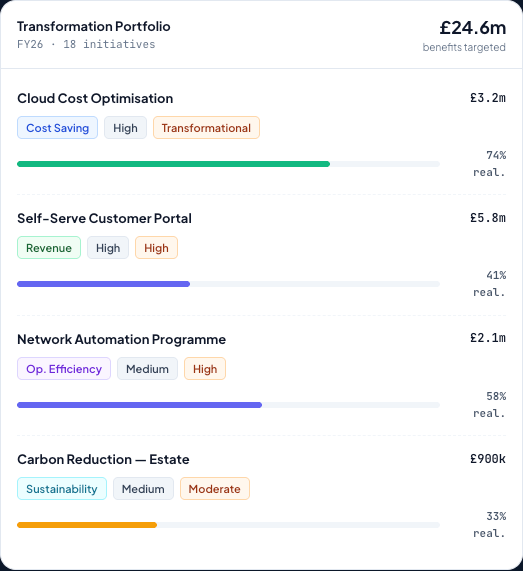
The Challenge
Transformation that cannot show its value is hard to defend
Boards approve initiatives on a business case, then have no reliable way to see whether the benefits arrived. Work gets prioritised on opinion, benefits get double-counted across overlapping projects, and the approved budget drifts away from what was actually committed.

The benefit case is never tested
A business case promises savings or revenue, the initiative completes, and nobody returns to check. Without a baseline, a target and a measured actual, delivered becomes a matter of opinion rather than evidence.

Prioritisation is an argument, not a method
When every initiative is high priority, funding decisions come down to who argues hardest. Without weighted, multi-criteria scoring, there is no defensible reason why one project was selected and another deferred.

Strategy and delivery drift apart
The strategy lives in slides, the projects live in a tool, and the link between them is in someone’s head. When that person moves on, no one can say which initiative a given project was meant to serve.
Initiatives
A complete record for every strategic initiative
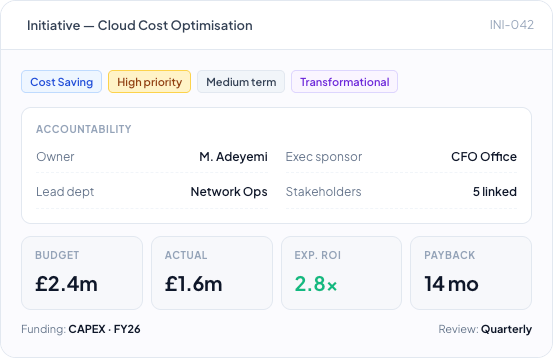
A transformation initiative is more than a title and a budget. DemandFlow® gives each one a single home covering its case, its governance and its progress, so oversight does not scatter across separate documents.

Categorised and prioritised
Every Initiative carries a category, from Cost Saving and Revenue Generation through Operational Efficiency, Innovation and Sustainability, plus a priority, a time horizon of short, medium or long term, and a business impact rating up to Transformational. The shape of the portfolio is visible at a glance.

Owned and sponsored
Each Initiative names an owner, an executive sponsor, a lead department, key stakeholders and an implementation team, each tied to the real person or team. Accountability is explicit and connected to real users, not typed into a free-text field.

Cased and reviewed
Approved budget, actual cost, expected ROI, payback period and funding source sit alongside objectives, success criteria and a set review frequency. The business case and the review cadence live together from the start.
Benefit realisation
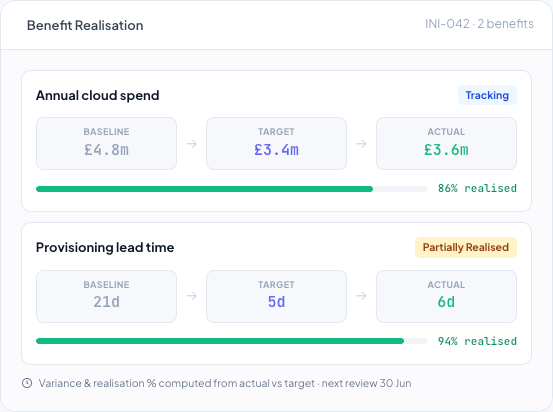
Benefits tracked from baseline to actual
A benefit you cannot measure is a benefit you cannot claim. DemandFlow® is built around the realisation question: what was the starting point, what did we target, and what did we actually achieve.

Baseline, target, actual
Each Benefit captures a baseline value, a target value and a target date, then an actual value and a realised date. A measure type of currency, percentage, number or boolean keeps the figures comparable, and an owner is accountable for the outcome.

Variance computed, not estimated
Variance and realisation percentage are derived from actual and target. DemandFlow® also asks how realisation was measured, so the evidence behind the number sits right next to the number itself.
Strategy alignment
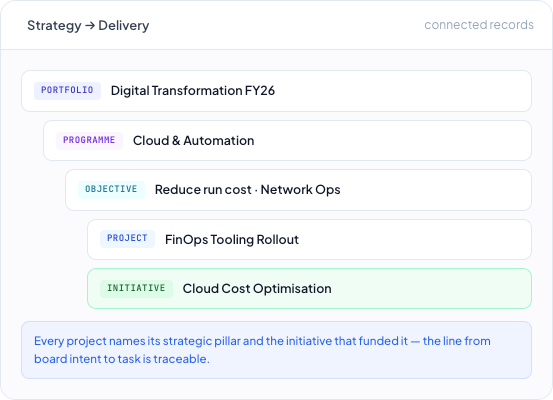
From strategic objective to the work that delivers it
Transformation only counts if the work serves the strategy. DemandFlow® links objectives, initiatives and projects directly, so the line from a board-level intent to a delivery team’s task is explicit and traceable.

Domain objectives
A Domain Objective links an initiative to a department, described as strategy-to-execution alignment. Each objective points to its parent Initiative, so departmental goals roll up to the strategic intent that justifies them.

Projects carry their strategic pillar
Every Project can name a strategic pillar through its objective link and can reference one or more linked initiatives directly. A project always knows which strategy it serves and which initiative funded it.

Portfolios and programmes above
Projects sit inside portfolios and programmes, the higher-level groupings that coordinate related work. The full hierarchy, from portfolio to programme to project to initiative, is held as a connected set of requirements rather than parallel lists.
Initiative to delivery
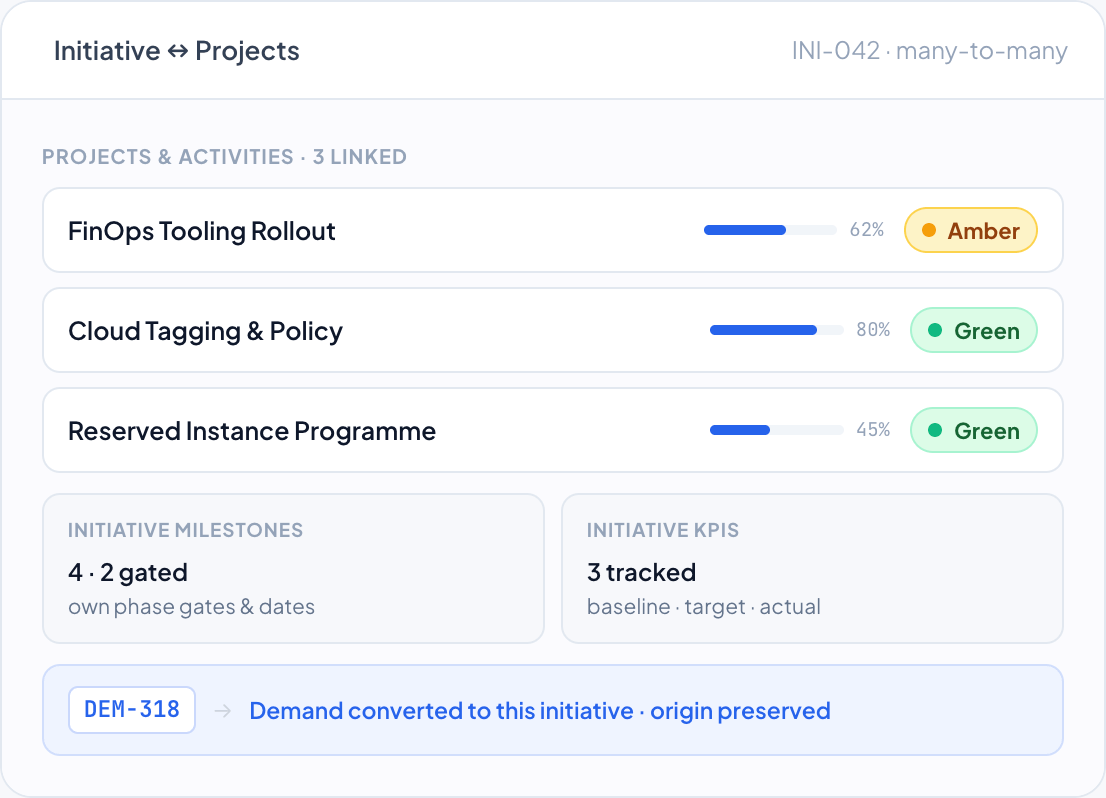
The link between an initiative and its projects
An initiative does not deliver itself. DemandFlow® connects each Initiative to the projects that carry it out, in both directions, so progress on the ground rolls up to the initiative it belongs to.

Many projects, one initiative
Each initiative lists the projects delivering it, and each project points back to the initiatives it serves. The link works both ways, and one project can serve several initiatives, matching how real transformation work spreads across a portfolio.

Milestones and KPIs on the initiative
Each Initiative carries its own milestones, with phase gates, approvals and target dates, and its own KPIs with baseline, target and actual values. Initiative-level progress does not depend on reading every child project individually.

Demand becomes initiative
Incoming requests are triaged and approved, then convert directly into initiatives or projects, with the origin of every initiative preserved, not lost at intake.
Prioritisation and scoring
Defensible decisions about what to fund
When budgets are finite, the question is not whether an initiative is good but whether it beats the alternatives. DemandFlow® scores work against weighted criteria and records the decision, so funding choices can be explained.

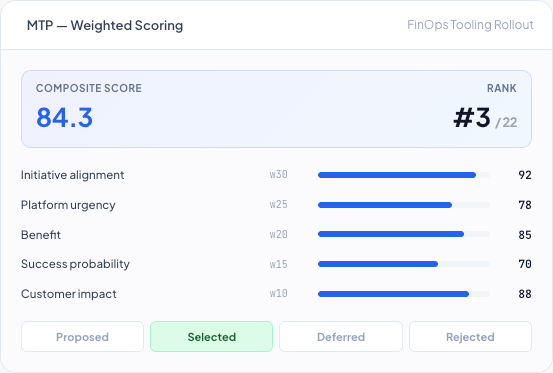
Five weighted dimensions
A medium-term plan scores each project on initiative alignment, platform urgency, benefit, success probability and customer impact. The weights are held on the plan and sum to one hundred, producing a composite score and a rank for every candidate.

No double credit for alignment
Initiative alignment uses a maximum-plus-small-bonus formula, so a project’s top initiative drives its score and additional links only nudge it. Work is not rewarded simply for being tagged to many initiatives.

The decision is recorded
Each project in a plan carries an explicit decision of Proposed, Selected, Deferred or Rejected, with a decision note. Scoring models and project scores apply the same multi-criteria discipline at portfolio level, and scenarios let teams compare what-if mixes against the baseline.
Plan to budget
Approved plans become committed roadmap budget
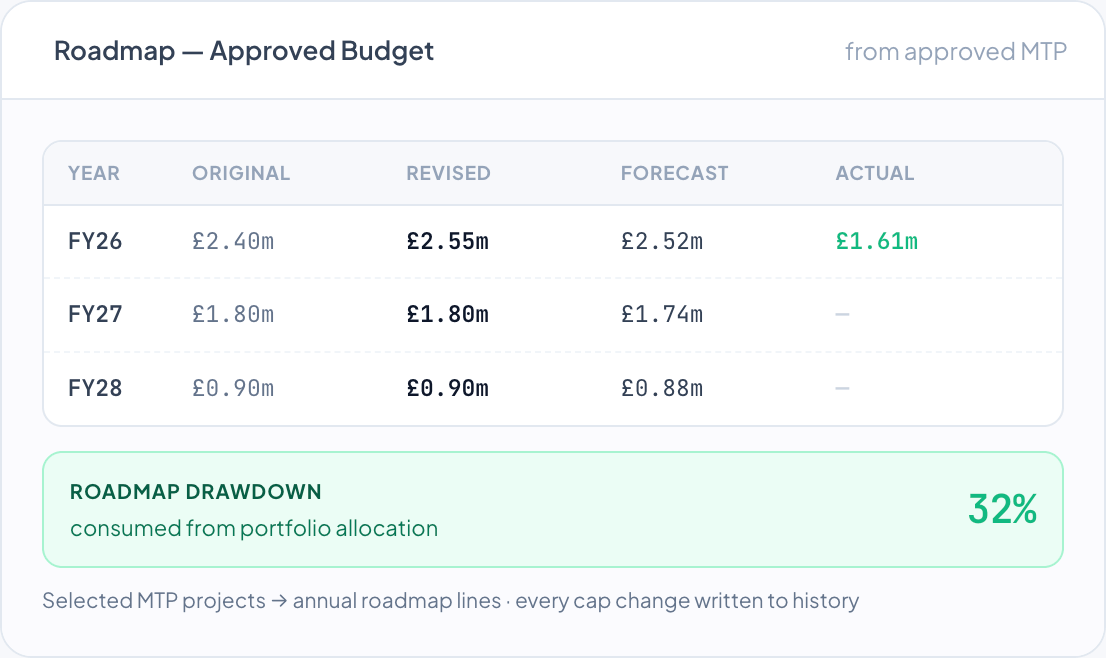
A plan that lives in a spreadsheet is a forecast, not a commitment. In DemandFlow® approving a medium-term plan turns its selected projects into roadmap budget lines, closing the gap between intent and the financial record.
Justifiable cost lines
Cost lines on a plan are built from real sources: resource templates, bills of materials, hardware requirements, components or contracts, not round numbers. Each line is a justifiable entry that can be traced back to what it pays for.
Approval generates roadmap lines
When a plan is approved for a fiscal year, the cost lines for that year aggregate into annual Roadmap Lines, each holding budget, revised budget, forecast and actual figures by month. The plan and the budget stay in step.
Drawdown and audit
Roadmap drawdown records how much budget each project consumes from its portfolio allocation, and budget cap changes are written to a history record every time they are set or amended. Both the spend and the changes to the limits are auditable.
Honest measurement
Count each benefit once, even when it's shared
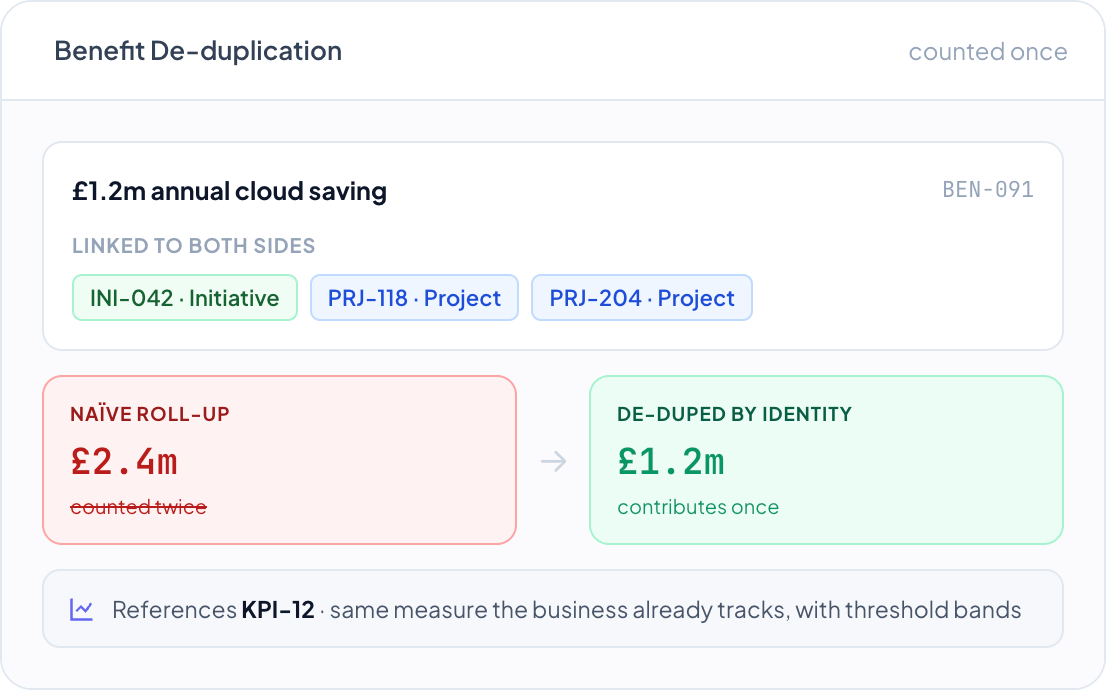
It’s easy to mistakenly claim a benefit several times if it is realised by several projects. DemandFlow® knows when a benefit is shared and counts it once, so the headline number is one you can defend.
Shared, not duplicated
A single benefit can belong to both an initiative and the projects delivering it, because that is the truth: the project that delivers a saving and the initiative that promised it are talking about the same money. DemandFlow® treats it as one benefit with two owners, not two separate wins.
Counted once in every total
Wherever benefits are added up, whether to score a project or to report on the whole portfolio, a benefit shared between an initiative and its project counts once, not twice. The totals stay honest without anyone reconciling them by hand.
KPIs join it up
Each benefit can point to a KPI the organisation already tracks, with its own baseline, target and actual. The proof of a benefit is a number the business already trusts, not one invented to make the case look good.
Make the value of transformation visible
DemandFlow® holds the whole chain in one connected model: the demand, the initiative, the objectives and projects that deliver it, the weighted scores behind every funding decision, the approved roadmap budget, and the benefits tracked from baseline to measured actual. When the board asks whether a transformation delivered what it promised, the answer is in the data, not in a deck. Book a demo to see initiatives, benefits and delivery joined up end to end.
One Platform. Strategy to Stack.
Ready to Take Control?
Join the leading companies who have transformed their technology management with DemandFlow®.
Book a personalised demo today.