
Telco Network Management
Your network estate as a single digital twin, from the rack rail to the routing label
DemandFlow® holds the physical estate and the logical network in one connected model. Sites, buildings, floors, rooms, racks and equipment sit alongside the platforms, VRFs, VLANs, label-switched paths and carrier services that run across them. Every cable, port and service is traceable end to end, so you can see what you own, where it sits and what depends on it.
The Challenge
Disconnected records hide the things that matter most
Most operators run the physical estate and the network in separate tools, and the gap between them is where capacity, risk and impact go unseen. A digital twin only works when the rack, the device and the service it carries are the same connected record.

Two estates, two tools
DCIM tells you about racks and power. Network inventory tells you about VRFs and circuits. When they live in separate systems, no one can answer a question that crosses the line, such as which carrier service depends on a specific power feed.

Capacity is guesswork
Without computed roll-up of rack units, power and cooling at every level, planners over-provision to stay safe. Stranded space, stranded power and stranded cooling are paid for every month and never reclaimed.

Change is risky
A device decommission, a firmware upgrade or a feed maintenance window can take down a service no one connected to it. If dependencies are not recorded, impact analysis becomes a meeting rather than a query.
Physical hierarchy
Model the whole estate as one nested structure
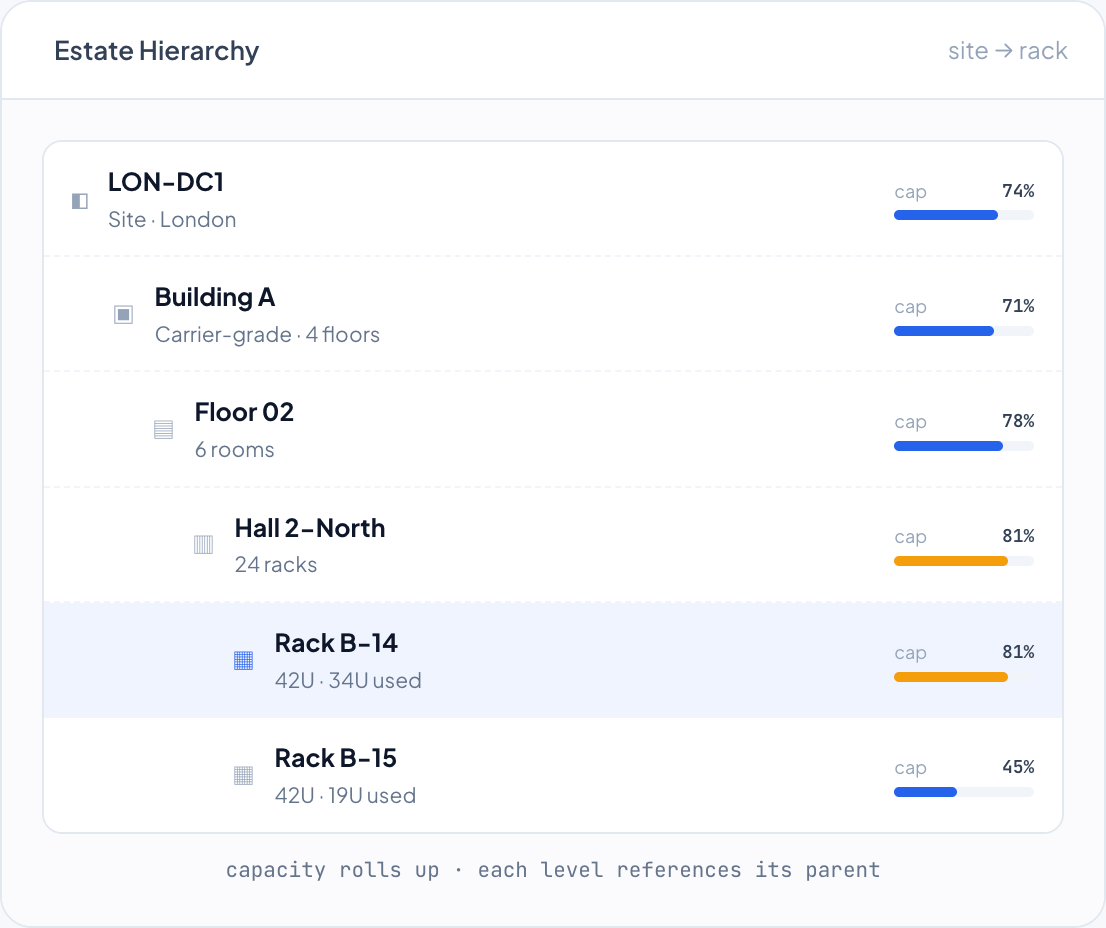
DemandFlow® models the physical estate as a strict hierarchy, from site down to the individual rack. Each level points to its parent, so the tree is always navigable and capacity rolls up cleanly. You record the estate once and query it from any angle.

Site to rack in one tree
The Site entity holds location, ownership and site type, and parents the Buildings beneath it. Buildings parent Floors, Floors parent Rooms, and Rooms parent Racks. Because each level references the one above, you can open a site and drill straight down to a single rack position without leaving the model.

Resilience and compliance recorded where it lives
Each Site carries Uptime Institute tier, security level, certifications such as ISO 27001 and SOC 2, and flood, earthquake and hurricane risk ratings. Buildings record construction type, seismic rating, LEED certification and certificate of occupancy, so resilience posture is part of the estate record, not a separate spreadsheet.

Documentation attached to the structure
Buildings hold links to floor plans, structural drawings, electrical schematics, mechanical drawings and life-safety plans. Floors and rooms carry their own plan links. The drawings stay attached to the physical object they describe, so the current layout is always one click from the record.
Space and power
See real headroom at every level, computed not estimated
Capacity in DemandFlow® is calculated from what is actually installed. Racks derive used and available rack units from the equipment mounted in them, and that headroom rolls up through rooms, floors, buildings and sites. Power and cooling are tracked the same way.

Rack space that counts itself
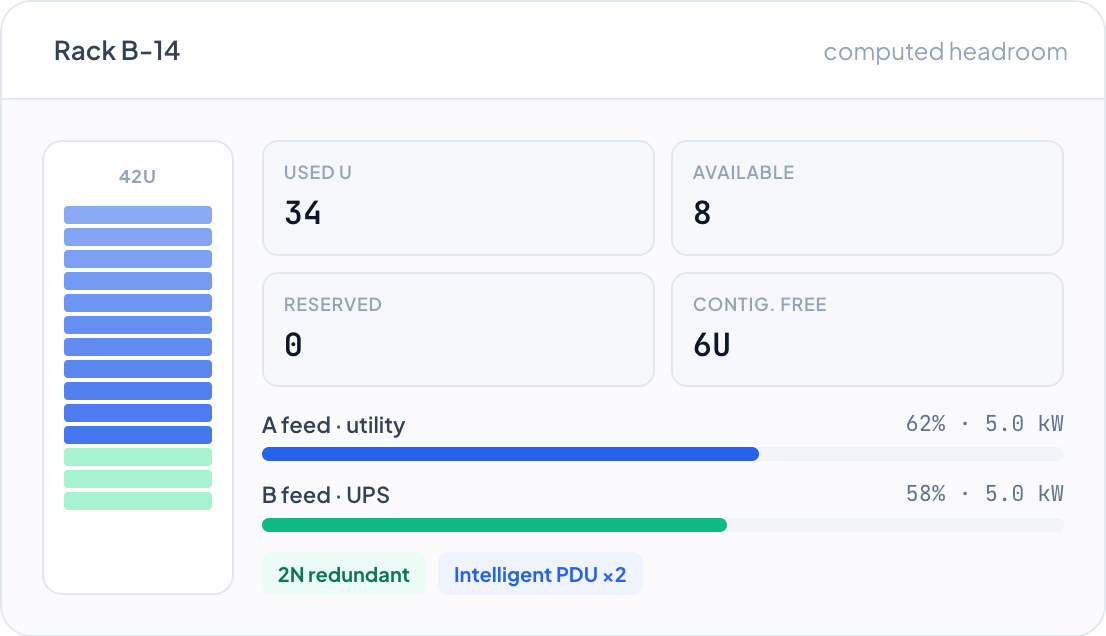
Each Rack records its height in U and computes used U, available U, reserved U and the largest contiguous free space from the assets mounted in it, shown as a utilisation gauge. You can find the rack with enough adjacent free U for a new chassis instead of discovering the gap is fragmented on install day.

Power tracked from feed to outlet
Power Circuit records voltage, amperage, phase, rated capacity, connector type and feed path, including whether it is a utility A feed or a UPS or generator B feed. Metering fields capture measured load, load percentage and power factor against the rated capacity, with warning and critical thresholds for proactive alerting.

Redundancy made explicit
Racks record power redundancy as N, N plus 1, 2N or 2N plus 1, along with PDU count and PDU type from basic through to intelligent. Rooms carry separate power and cooling redundancy classifications. Resilience is captured as structured data you can report on, not a note in a comment field.
Equipment and inventory
Every asset placed, costed and connected
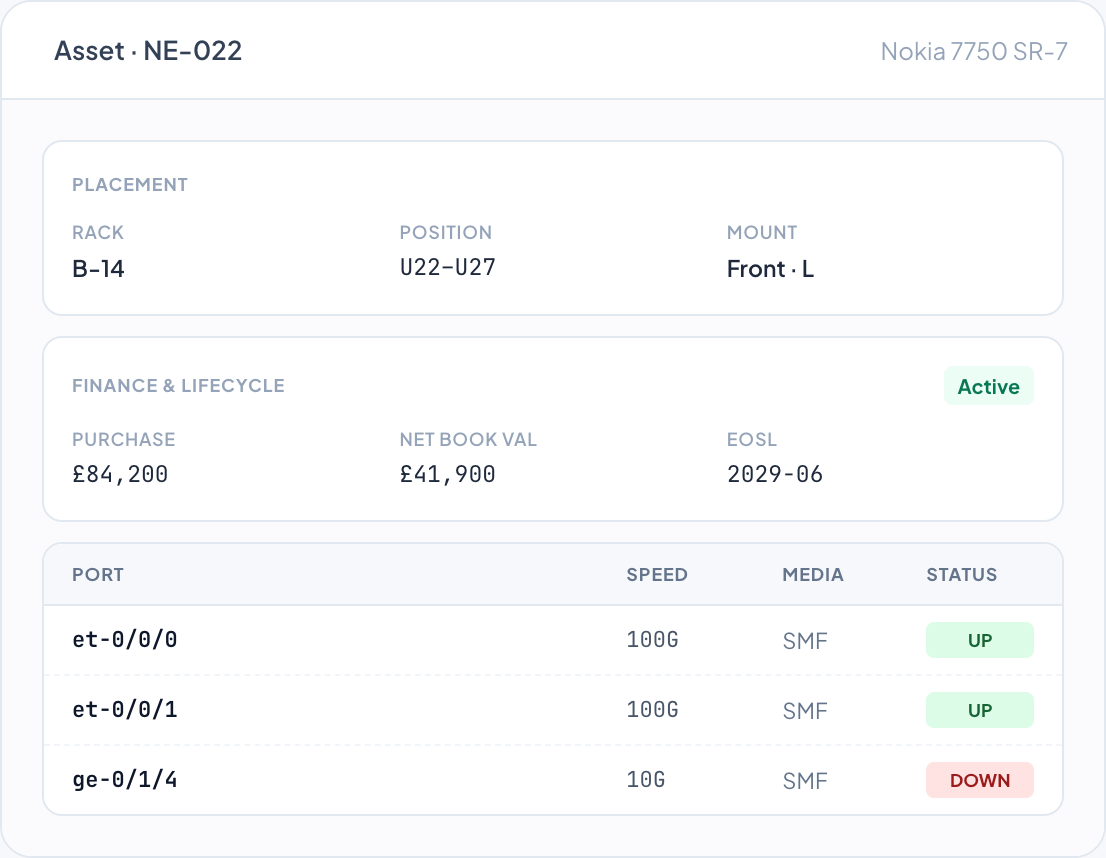
The Asset record is the join point between the physical estate and the logical network. It knows where it is mounted, what it cost, where it sits in its lifecycle and which network constructs run across it. One record carries placement, finance and connectivity.

Placed to the U
Each Asset references its parent rack and its U position, with mount position front or rear and left or right, plus height in U and power draw in watts. Because assets sit inside racks inside rooms inside floors, you always know the exact physical location of any device, down to the rack unit it occupies.

Finance and lifecycle in the same place
Assets carry purchase cost, depreciation method, net book value, accumulated depreciation, useful life and end-of-service-life date, alongside lifecycle status from active through deprecated, end of life and end of support. Disposal is covered too, with ITAD and WEEE fields including wipe method to NIST 800-88 and certificate references.

Ports and cabling that map the real wiring
Each asset owns Port records that capture type, speed from 100 Mbps to 400 Gbps, media type, MAC and IP address, admin and operational status, and transceiver. Connection records join two ports with cable ID, media, length and test results, and group into logical end-to-end connections, so the physical wiring is documented link by link.
Environmental and DCIM
Watch the room conditions that protect the equipment
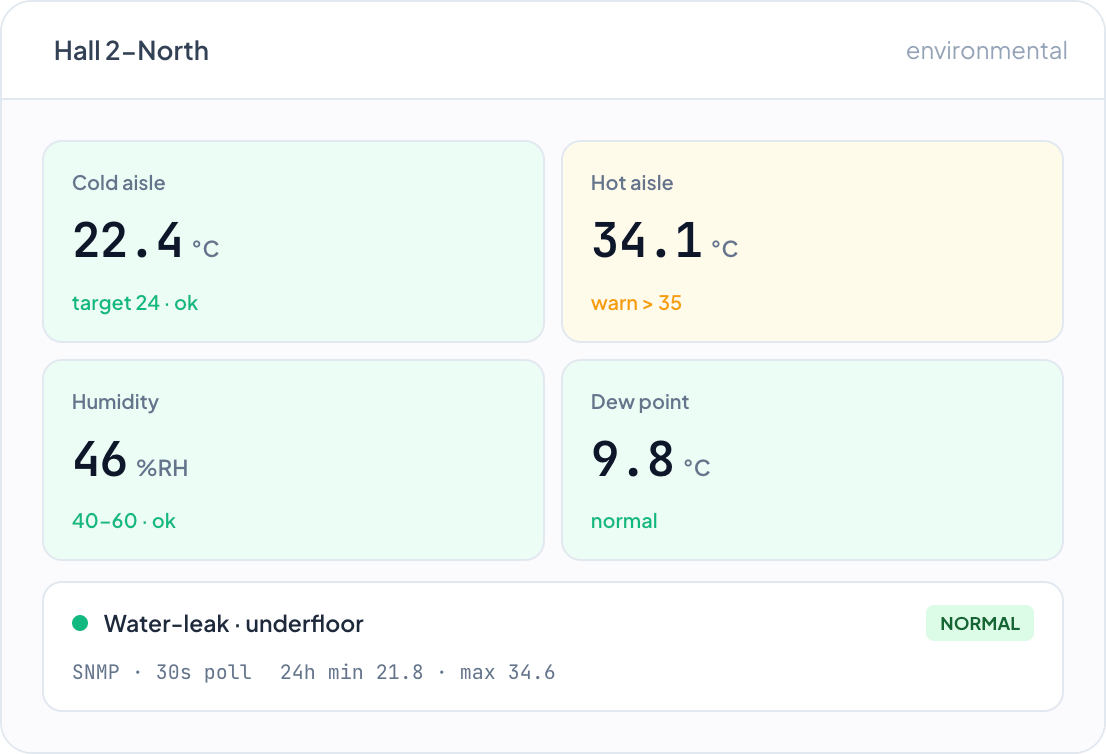
DemandFlow® records environmental and power telemetry against the design thresholds you set. Sensors are placed in the model at a known room, rack or tile and mount position, so a reading is always tied to a physical location and the equipment around it.

Sensors that know where they are
Each Environmental Sensor is placed by room, rack or floor tile with a mount position such as cold aisle, hot aisle, underfloor or CRAC unit. Sensor types cover temperature, humidity, dew point, differential pressure, airflow, water leak, smoke and door contact, polled over SNMP, Modbus, BACnet, MQTT, Zigbee or LoRaWAN.

Thresholds and alarm state built in
Sensors hold warning and critical high and low thresholds for temperature and humidity, a dew point warning and a current alarm state from normal through warning, critical, leak alarm and communication loss. Twenty-four-hour minimum, maximum and average readings give context for whether a reading is a spike or a trend.

Containment and cooling modelled at the rack
Racks record airflow pattern and containment type, including hot aisle, cold aisle, chimney and full containment, with top, middle and bottom temperature readings. Rooms and floors track CRAC and in-row unit counts, raised floor, target temperature and humidity and leak detection, so the cooling design is documented alongside the live readings.
Logical network layer
Run the network as platforms that sit on real hardware
Above the physical estate, DemandFlow® models the network as platform instances. Each instance has a type, an environment, a criticality and a deployment model, and links to the assets, clusters and addressing it uses. The logical layer is anchored to the physical layer it depends on.

Platform instances with a deployment model
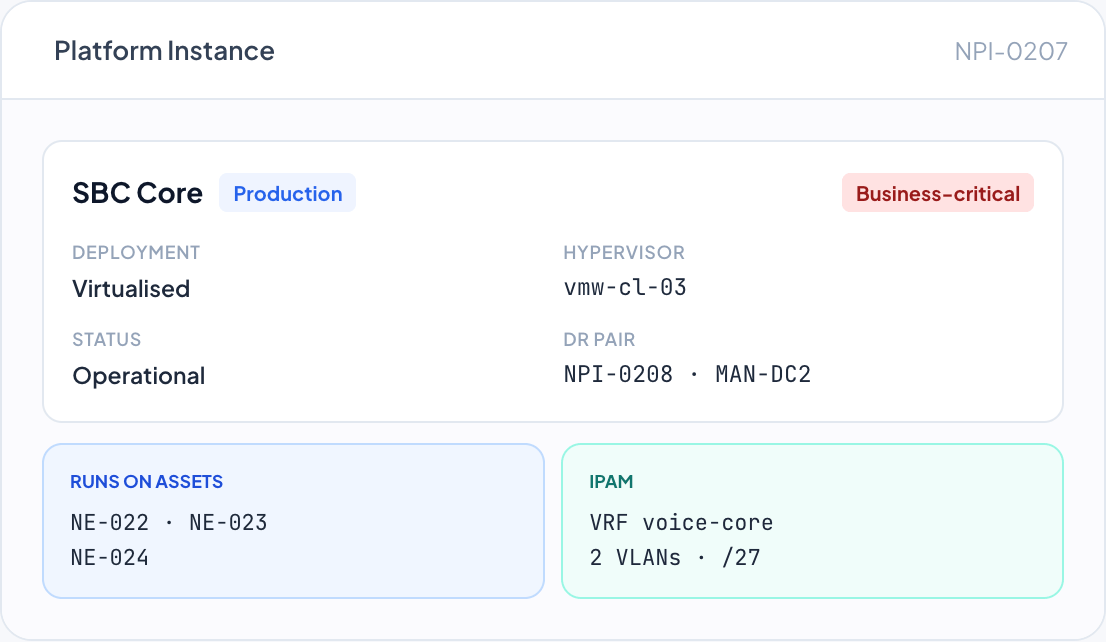
A Network Platform Instance records its platform type, environment from production through disaster recovery and lab, status, criticality and deployment model, whether physical, virtualised, cloud-native, containerised or hybrid. Virtualised and containerised instances link to their hypervisor cluster or Kubernetes cluster, so the hosting is explicit.

Bound to hardware and addressing
Each instance links to the assets that run it and to its IP address management, including VRFs, VLANs and prefixes. Assets in turn carry a network platform reference, so the relationship is navigable from both ends. The logical function and the box it runs on are never more than one hop apart.

Platform and DR dependencies recorded
Platform instances record dependencies on other platforms in both directions and pair with their disaster-recovery counterparts. Network tickets, changes and problems attach to the instance, so operational history lives with the platform rather than scattered across separate systems.
Configuration and services
Capture transport and carrier services as real telco constructs
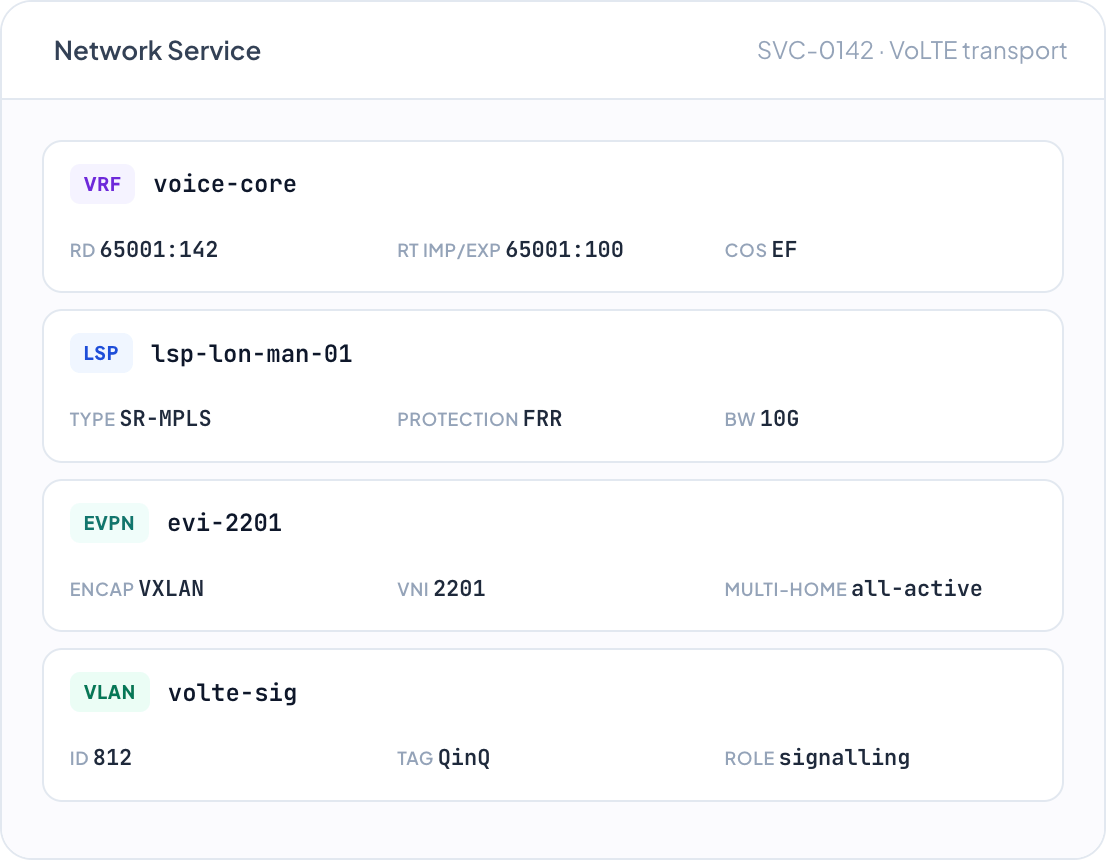
DemandFlow® models the configuration layer with the fields a telco network actually uses. VRFs carry route distinguishers and route targets, label-switched paths carry protection and class of service, and EVPN instances carry encapsulation and multi-homing. Carrier services sit on top and trace down to every construct that carries them.
VRFs, VLANs and label-switched paths
VRF records route distinguisher, import and export route targets and class of service. VLAN records its ID, tagging from 802.1Q to QinQ, role and group. The label-switched path entity records type such as RSVP-TE or SR-MPLS, service type, ingress and egress device and interface, reserved bandwidth and protection mode including fast reroute.
VPLS and EVPN instances
The EVPN Instance records its EVI, encapsulation across EVPN-MPLS, VXLAN, SRv6 and Geneve, VNI, route distinguisher, route targets, multi-homing mode and IRB type. VPLS instances and Ethernet segments are modelled alongside, so Layer 2 VPN services are described with the same precision as the rest of the estate.
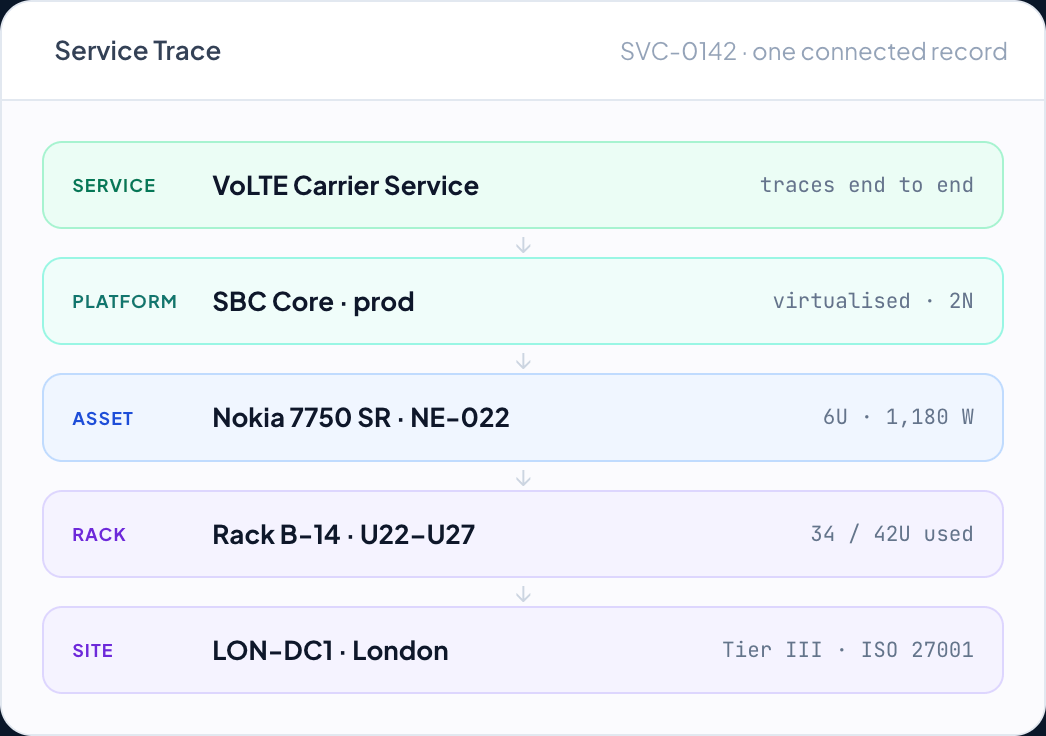
Carrier services that trace end to end
The Network Service entity links to platform types and instances, assets, ports, VRFs, VLANs, label-switched paths, VPLS and EVPN instances. Service dependencies record whether one service depends on, is a component of or integrates with another, with a criticality and mitigation notes, giving a service-of-service map across the estate.
Impact analysis
Ask what depends on this, and get an answer from the model
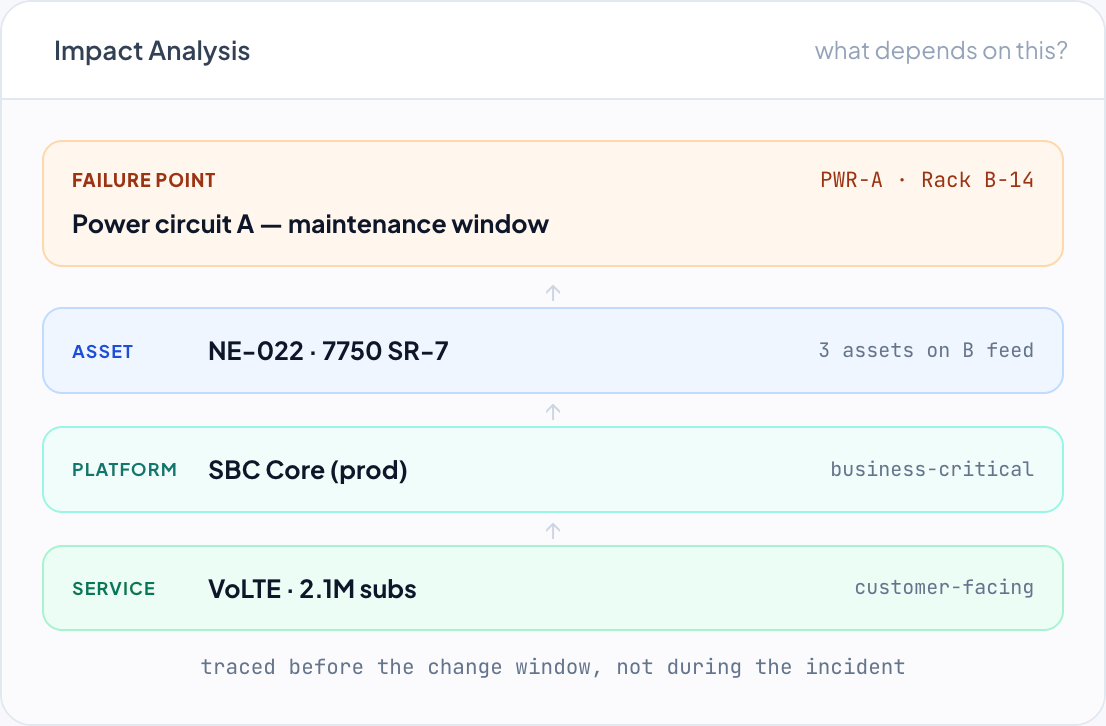
Because the physical and logical layers are one connected model, impact questions become queries rather than meetings. A device, a feed or a platform can be traced upward to the services it carries and downward to the infrastructure it relies on, all from records you already maintain.
Trace a fault to the services it affects
An asset links to its label-switched paths, its VPLS and EVPN instances and its carrier services. A power circuit links to its rack and the equipment in it. Starting from any physical failure point, you can follow the links to the services that would be affected, before a change window rather than during an incident.
One source of truth across teams
Facilities, infrastructure and network teams work from the same nested model. The rack a facilities engineer audits is the rack an asset sits in, which hosts the platform a network engineer manages, which carries the service an account team sells. No reconciliation between systems is required.
Plan change with dependencies in view
Network and platform dependencies are recorded in both directions, and disaster-recovery pairings are explicit. Network changes and problems attach to the platform instance. Planning a migration or a decommission, you can see the upstream and downstream dependencies as structured data and scope the work accurately.
One model for the estate you run and the services you sell
DemandFlow® gives telco operators a single digital twin that reaches from the physical site to the routing label and the carrier service. Capacity rolls up, conditions are monitored against your thresholds, and every service traces down to the hardware, power and addressing that carry it. The result is faster planning, safer change and an estate you can actually answer questions about. Book a demo to see your own network in the model.
One Platform. Strategy to Stack.
Ready to Take Control?
Join the leading companies who have transformed their technology management with DemandFlow®.
Book a personalised demo today.