
Platform Lifecycle Management
Your Medium Term Plan. AI Generated, Not Assembled By Hand.
Create a costed, multi-year project portfolio in a single click – driven by the lifecycle data you already hold.
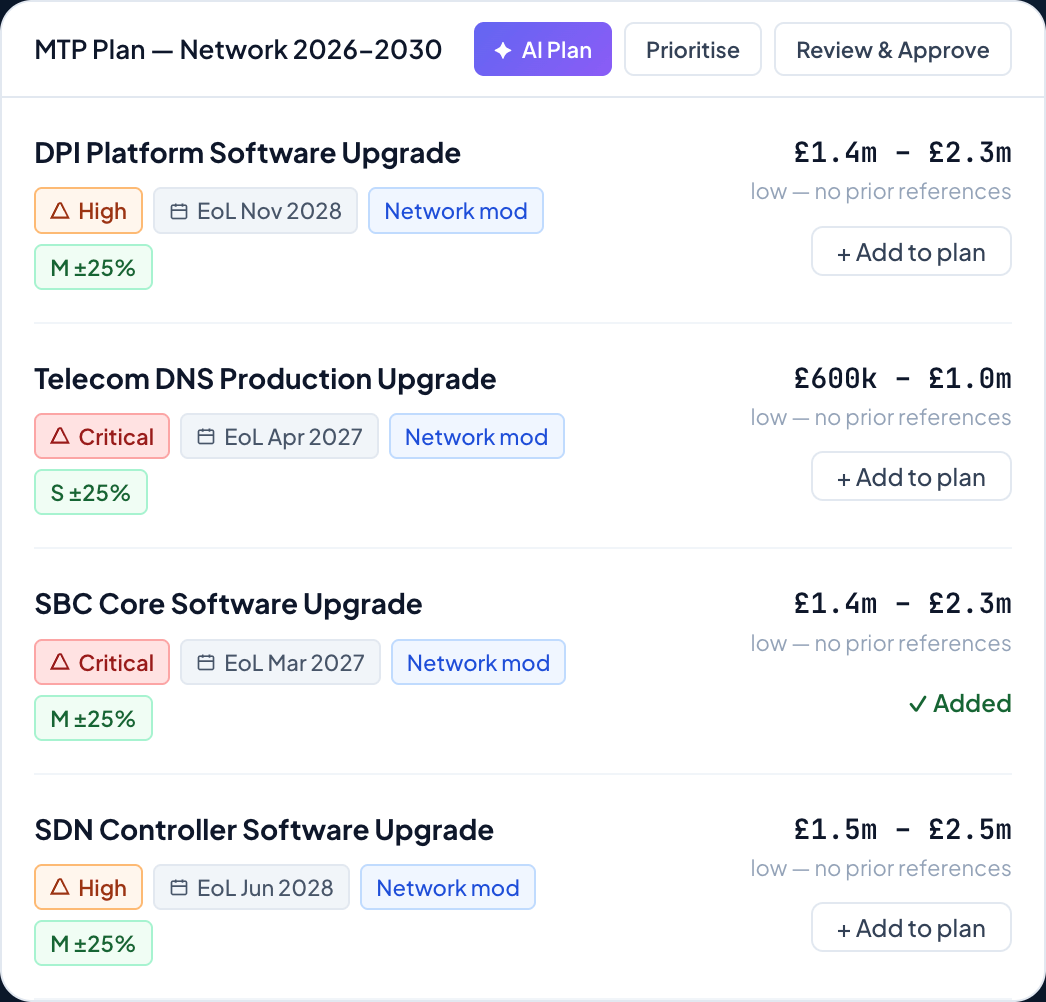
One-Click Generation
Two months of planning work. Done in minutes.
A single action turns the current state of the technology estate into a complete draft plan. The work that normally consumes a planning team for two or three months – chasing lifecycle dates, costs, and capacity headroom – completes in minutes. No spreadsheets exchanged, no inputs re-keyed.

Single action, complete output
One click reads the estate, applies lead times, anchors costs, and returns a sized, justified project for every upgrade the estate will need across the plan horizon.

Planners review a draft, not a blank page
Rather than building the plan by hand, planners review and approve a populated draft – making editorial judgements rather than administrative ones.

No parallel data collection
No spreadsheets exchanged between teams, no inputs re-keyed, and no information sitting in a personal mailbox waiting for someone to ask the right question.
Lifecycle Intelligence
The platform already knows what needs to be planned.
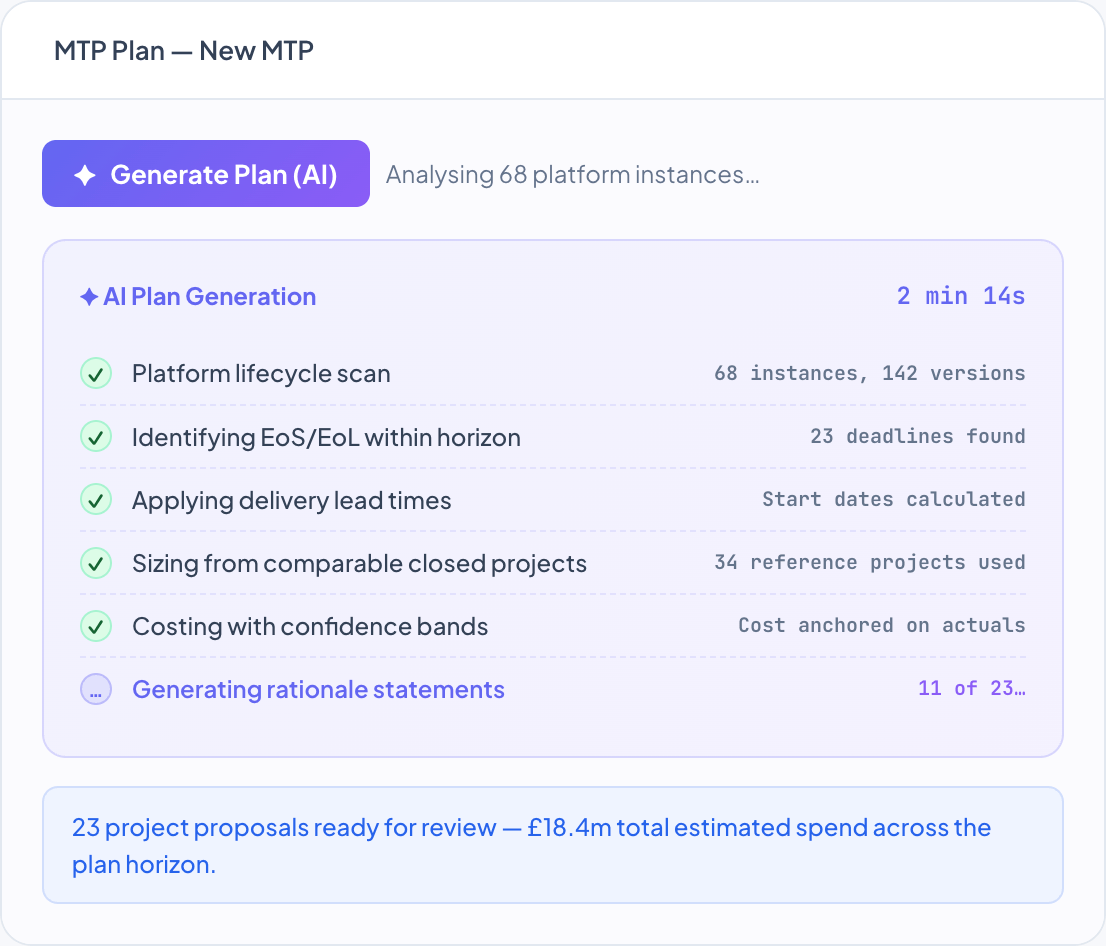
The application reads every deployed platform instance and identifies the software and hardware versions that reach end of support inside the plan horizon. Delivery lead times are applied to set the latest acceptable start year for each upgrade – so nothing is proposed too late to land before the deadline.

End-of-support scanning
Every deployed platform instance and component version is scanned against the plan horizon. Nothing is missed because nothing is manually entered.

Delivery lead times applied
Latest acceptable start years are calculated automatically – so the plan always proposes projects that can still land in time, not ones that are already too late.

Capacity adjustments included
Software and hardware components tracked at the version level – with general availability, end of sale, end of support, and end of life dates captured for every release.
Cost Intelligence
Every project arrives with a number behind it.
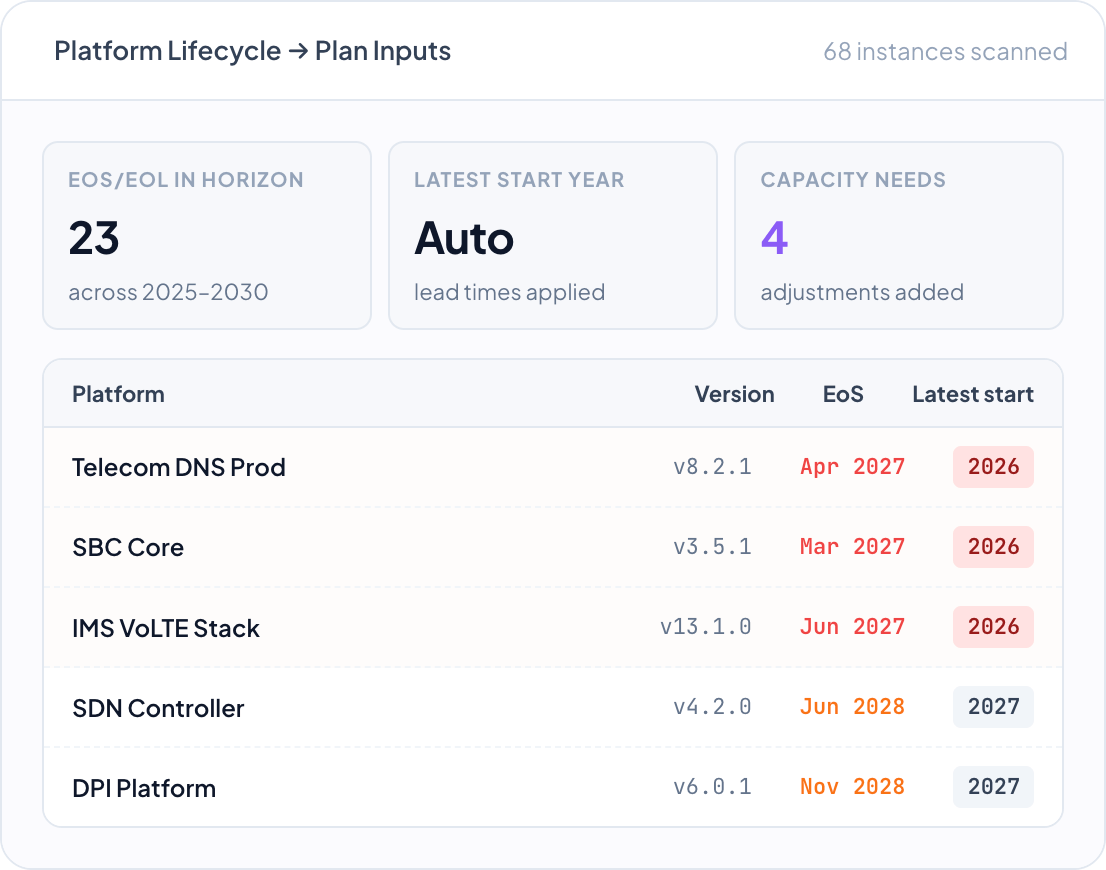
Each need is returned as a project proposal with a name, description, recommended start and end year, t-shirt size, and an estimated cost with a confidence band. Costs are anchored on the actuals of comparable closed projects in the same tenant - split across configured spend types, with a project management allocation always included.

Anchored on your own actuals
Cost estimates reference comparable closed projects within your own tenant – so the numbers reflect your vendor relationships, team rates, and delivery patterns, not industry averages.

Confidence bands, not false precision
Each estimate carries a confidence band and a note on the number of prior references used. Planners see exactly how much certainty sits behind each number before they approve it.

Spend types broken out
Costs are split across configured spend types – hardware, software, labour, professional services – with a project management allocation always included in the forecast.
Continuity
Projects already in flight are extended, not replaced.
Projects already underway are extended rather than re-invented. The application sizes only the remaining scope, reuses the existing project name and identifier, and leaves committed spend untouched – so in-flight programmes aren’t disrupted by the planning cycle.

Existing projects preserved
The AI sizes only what is left to do – not the full project cost – so forecasts reflect actual remaining exposure, not a full re-plan.

Remaining scope only
OPEX aggregates across the full network estate. Slice it by platform type, vendor, region, or spend category – without a reconciliation exercise at the end of each period.

No duplication
Platform instances already covered by an active upgrade project are excluded from new proposal generation. The plan adds what is missing, not what is already in motion.
Decision Support
No platform left unprotected.
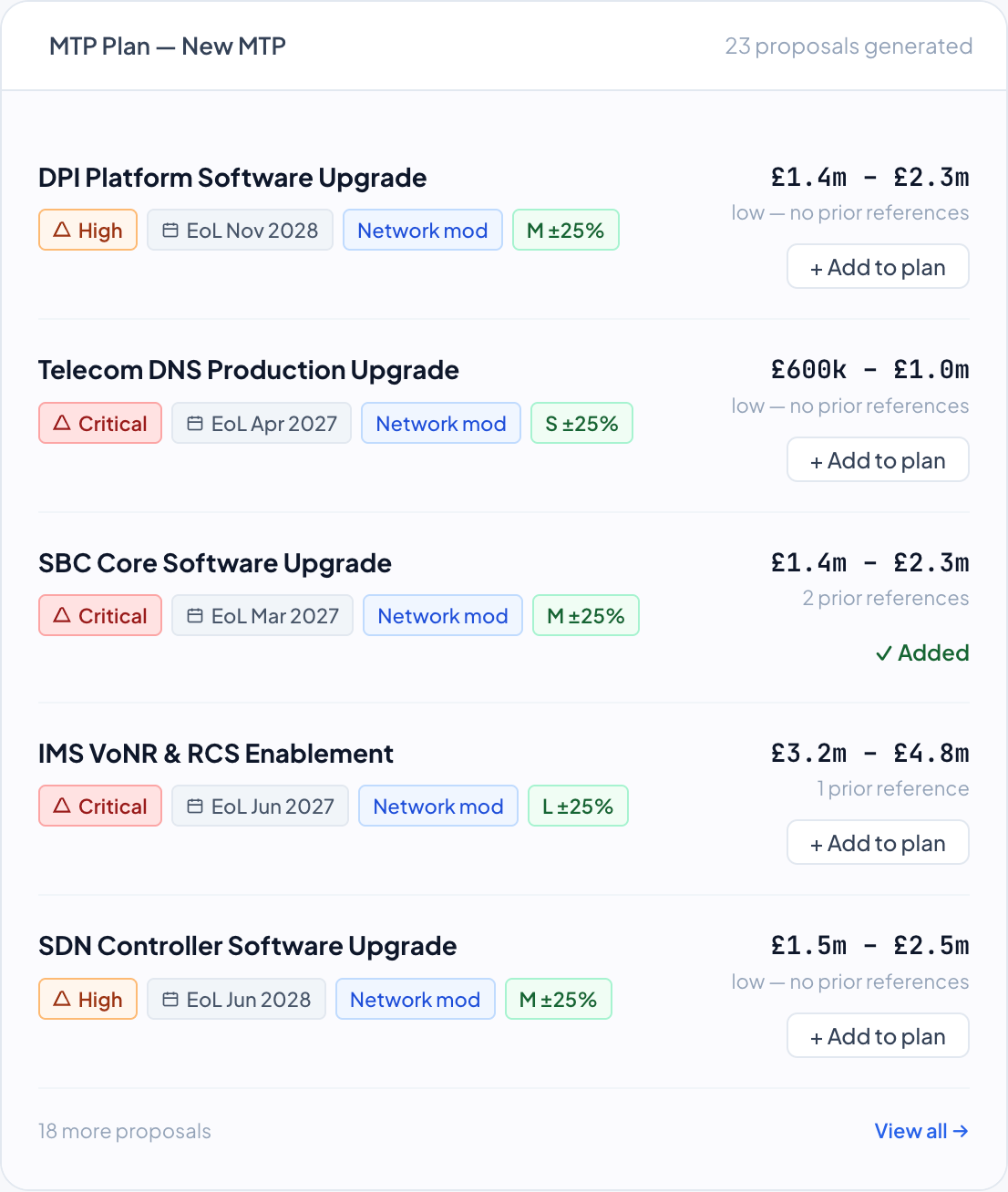
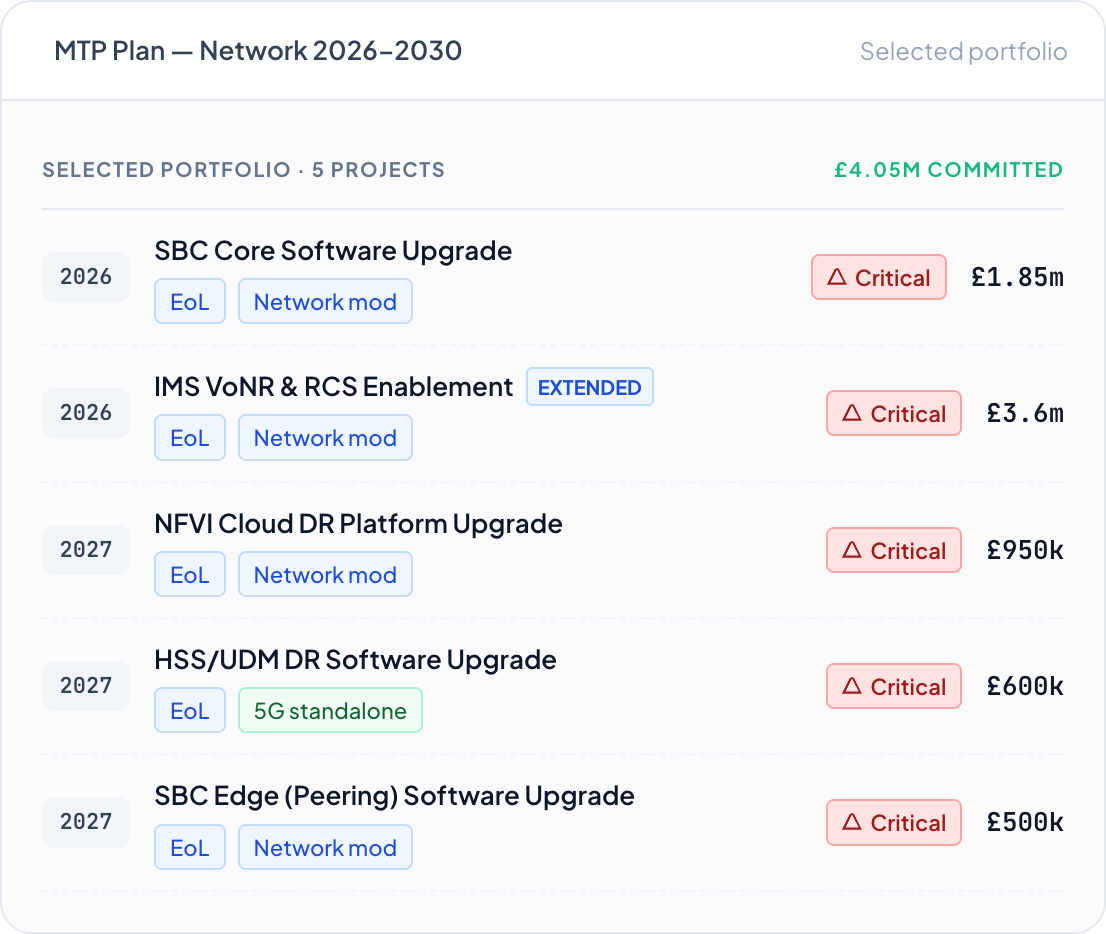
Every proposal arrives with a priority, driver type, category, and a short rationale citing the lifecycle date and the cost references used. Planners see why each project is in the plan and what evidence sits behind the number – so review and approval is a judgement call, not an information-gathering exercise.
- Carrie Hart Head of Mobile Delivery, BT

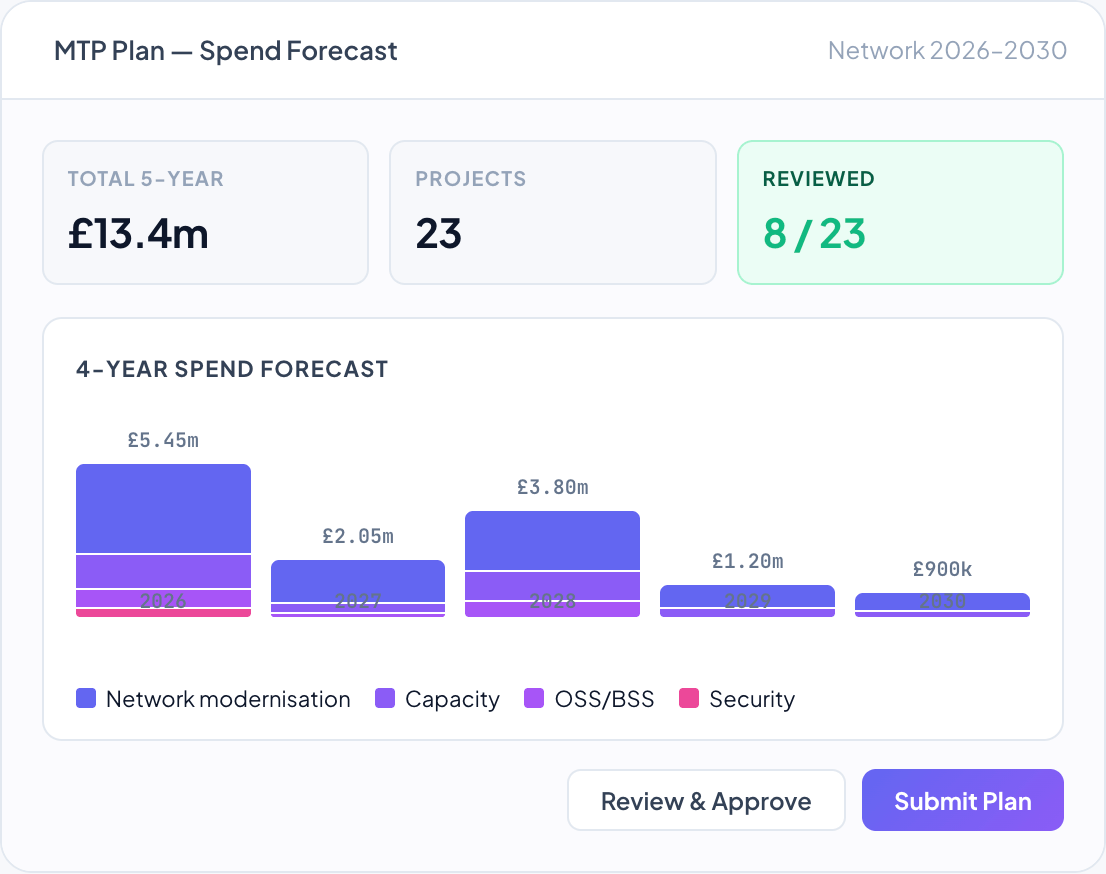
Spend forecast by year and category
The full 4-year spend forecast is visible by year and spend category the moment the plan is generated – no assembly required.

Rationale with every proposal
Every project includes a plain-language rationale citing the lifecycle deadline and cost references used. Approvers see the reasoning, not just the number.

One-click review and approval
Planners move from generated draft to approved plan without leaving the platform. Review, adjust, and submit – entirely within DemandFlow.
Your first AI plan, built on your real data.
Book a walkthrough and we’ll run the AI Medium Term Planner live for you – so you can see the for yourself how easy it is to generate the proposals, the cost anchors, and the rationale to drive your network forward.
"These tools transformed how we planned and delivered our network roadmap."
One Platform. Strategy to Stack.
Ready to Take Control?
Join the leading companies who have transformed their technology management with DemandFlow®.
Book a personalised demo today.