Why Your Approved Financial Roadmap Should Not Live in a Spreadsheet
Most organisations can tell you what they have approved spending money on this year. It just takes them a week and three phone calls to do it.

Most organisations can tell you, with some confidence, what they have approved spending money on this year.
It just takes them a week and three phone calls to do it.
The “approved plan” lives in one place. The actual financial commitments live in another. The list of projects that finance signed off lives in a third. The version the exec saw last month is in someone’s inbox. And the version the PMO is working from has two additions that haven’t been through approval yet but everyone is pretending they have.
The Roadmaps view in DemandFlow is built to be the single answer to one question. What have we approved, with budget attached, and when is it happening?
One version of the truth, by design
The Roadmaps view only shows work that has been formally approved with budget against it. Nothing in flight that hasn’t been signed off. Nothing wishful. Nothing that “we’re definitely doing but it hasn’t gone through governance yet”.
That sounds restrictive. It is the point.
The moment your roadmap contains a mixture of approved, proposed, aspirational and quietly in flight, it stops being a financial commitment and starts being a wish list. The Roadmaps view holds the line. If it is on the roadmap, the money has been agreed. If the money has not been agreed, it is not on the roadmap.
This gives the CFO, the exec and the board a single answer they can act on, instead of four overlapping answers they have to reconcile.
It moves when reality moves
The second thing the view does is reflect what is actually happening to the approved plan, in real time.
A project’s start date slips. The roadmap shows it. A milestone gets brought forward. The roadmap shows it. A piece of approved scope gets descoped. The roadmap shows it. A new initiative is taken through approval and added. The roadmap shows it.
Nobody is maintaining a parallel artefact. Nobody is reformatting slides the day before steerco. The roadmap is a view onto the approved financial commitments as they currently stand, drawn fresh every time someone opens it.
That changes the conversation in governance meetings. Instead of arguing about whether the deck is up to date, the discussion moves straight to whether the plan still makes sense.
It shows the money, not just the work
A roadmap that only shows project names and timelines is half a roadmap.
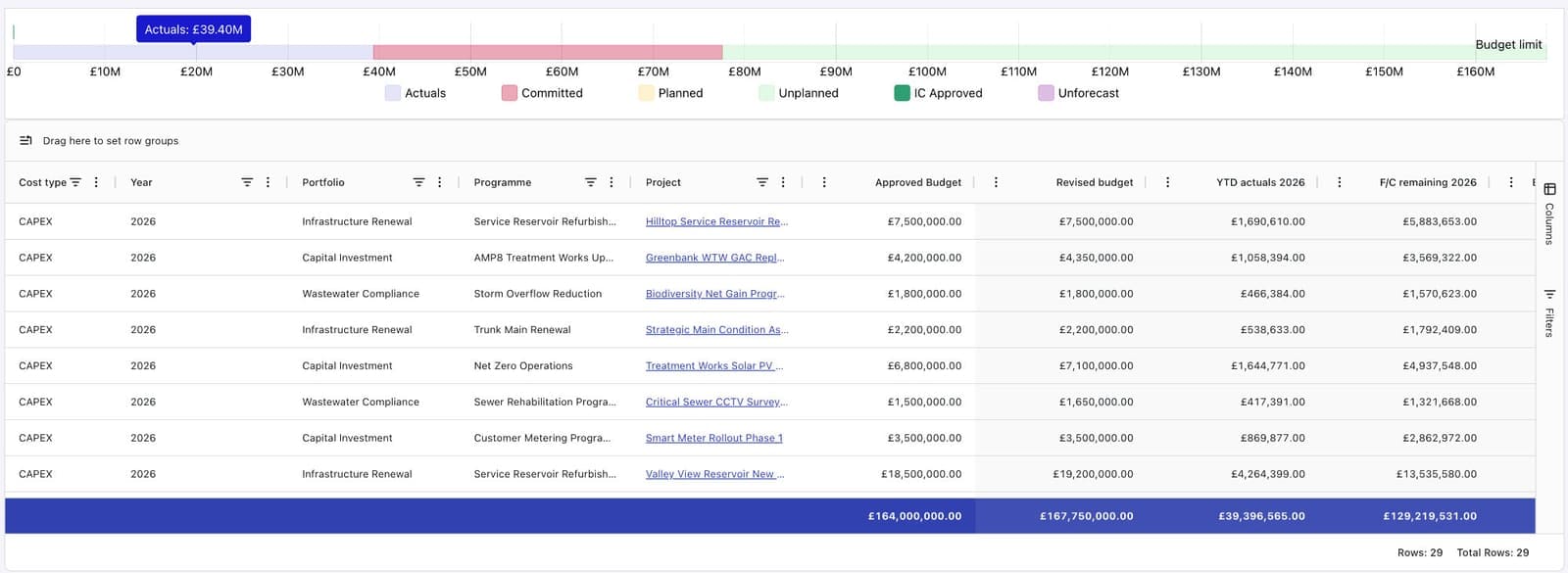
The Roadmaps view sits on top of the financial commitments, so the same view that shows you what is happening also shows you what it costs and when. Spend by quarter. Spend by business area. Spend by strategic theme. Spend by portfolio.
This matters because the questions that come at this view are almost never “what are we doing”. They are “where is the money going”, “are we still inside the envelope”, and “what would it cost to add this in”. Having the financial dimension built into the same view, drawn from the same approved data, means those questions get answered immediately rather than triggering a finance request.
It separates approved from aspirational
Plenty of tools let you build a roadmap by dragging boxes around on a canvas. That is fine for a workshop. It is not fine for the document your CFO is going to be held to at year end.
The discipline of the Roadmaps view is that it shows what has cleared governance. Aspirations, ideas, candidates and proposals live elsewhere in DemandFlow, where they belong. They flow into the roadmap when, and only when, they have been approved with budget.
This separation is what makes the roadmap trustworthy. Everyone knows what they are looking at. Everyone knows what it means to be on it. And everyone knows what has to happen for something to get on it.
The bigger point
Most organisations do not have a roadmap problem. They have a confidence problem. Nobody is quite sure whether the plan they are looking at is the latest one, the approved one, or someone’s preferred version of it.
A roadmap view that only ever shows the approved financial plan, that updates itself, and that ties directly to the money, solves that. It does not make the plan easier. It makes the plan honest.
And an honest plan is the one you can actually run the business from.