Keeping the Platform Running Is Not Free. So Where Does the Money Go?
Change spend gets the governance. Business cases, approvals, a roadmap, a tracker. Run spend, the cost of keeping what you already built alive, gets a single budget line and a shrug. Most organisations cannot tell you what platform maintenance actually costs, because nobody ever itemised it.

New work gets all the attention. A new project arrives with a business case, an approval, a roadmap line and a finance tracker watching every pound of it. Everyone knows what it is meant to cost and whether it is staying inside that number.
The cost of keeping what you already built alive gets a single budget line and a shrug.
Platform maintenance, run, business as usual, keeping the lights on. Whatever you call it, it can be the larger of the two numbers and the one nobody can break down. Ask most organisations what it costs to keep a given platform running for a year and you will get a total. Ask them what that total is made of and the room goes quiet.
Run cost hides because nobody itemises it
Change spend is legible because it is organised around a thing. The project. Every cost has a project to attach to, and the project has an owner who cares whether the number is right.
Run cost has no such anchor. It is a licence renewal here, a support contract there, a cloud bill that arrives monthly, a maintenance window staffed by three people for a weekend, a vendor on a standing retainer. Each item is small enough to wave through and none of them is anyone’s project. So they land in a cost centre, get summed once a year, and the only question ever asked of them is whether the total went up.
It almost always goes up. Nobody can say which part.
What platform maintenance actually contains
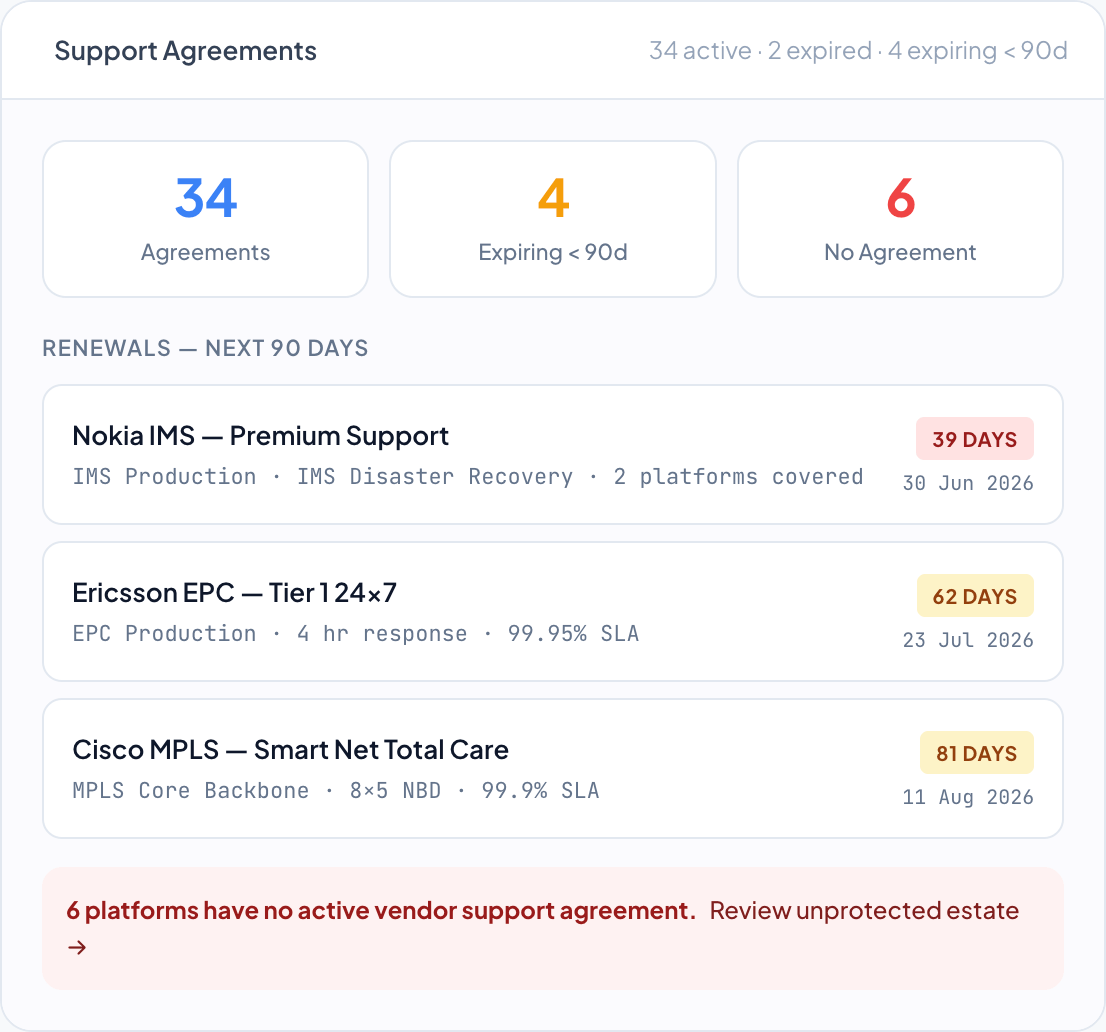
When you do break it down, the cost of keeping a platform alive is rarely one thing. It is software licences and subscriptions. Vendor support and maintenance contracts. Cloud and hosting. The people who run it, whether that is a dedicated team or a slice of several. Third-party services it depends on. The periodic work that is not a project but still costs money, such as upgrades, patching cycles and certificate renewals.
Each of those is a different kind of spend, with a different owner, a different vendor and a different reason for changing. Rolled into a single annual figure, they tell you nothing. Held as lines, they tell you where the money is going and which part is growing.
The same tracker, pointed at run instead of change
The finance tracker in DemandFlow does not only have to watch projects. The same detailed structure that tracks forecast and actual spend on a project to change the network works just as well on the ongoing cost of a platform or service.
A platform carries its own finance position. Forecast and actual cost by month, split by spend type, by vendor, by the contracts and people behind it. The cloud bill sits on its line. The support contract sits on its line. The run team’s time sits against the platform it maintains. The total is still there, but now it is a total made of parts you can name, rather than a number that simply appeared.
And because run and change sit in the same model, you can finally see them together. The true cost of owning a platform is the project that built it plus every year of keeping it alive. When both halves are tracked the same way, total cost of ownership stops being a once-a-decade consultancy exercise and becomes something the record already holds.
Spend type is the unlock
The question that makes run cost manageable is not how much. It is what kind.
How much of this platform’s run cost is fixed contract and how much is consumption that we could influence? How much is going to a single vendor? Which line grew this year, and was that a price rise or more usage? None of those questions can be answered from a total. All of them can be answered the moment the spend is held by type, vendor and month.
That is the difference between a maintenance budget you defend and a maintenance budget you manage. One is a number you are asked to justify after the fact. The other is a position you can act on while there is still something to act on.
The bigger point
Organisations put enormous governance around the money they spend to build things and almost none around the money they spend to keep them running. Yet the run cost is the one that compounds, year after year, long after the project that created it has closed.
You cannot optimise what you cannot see. Giving platform maintenance the same line-level visibility that change work already has does not make the bill smaller on its own. It makes the bill legible, which is the first thing that has to be true before anyone can make it smaller.